


Many people believe that sleeping longer automatically increases energy, but this is not true. The quality of your sleep, not the total hours you sleep, determines how alert and productive you will be during the day. Even if you sleep for eight or nine hours, poor-quality sleep can leave you feeling tired and sluggish. Understanding and managing your sleep effectively is crucial for maintaining both physical and mental well-being.
To improve sleep, it is essential to understand sleep cycles, also known as sleep stages. Sleep is not a continuous, uniform process; it is divided into cycles, each lasting around 90 minutes. A typical sleep cycle consists of three main stages: light sleep, deep sleep, and REM sleep. Light sleep is the initial stage when you fall asleep. Deep sleep is the most critical stage for your body—it promotes muscle growth, releases growth hormones, and restores physical energy. REM sleep is the stage where memory consolidation, mental health restoration, and emotional processing occur. Research from leading sleep institutions like the National Sleep Foundation emphasizes that the quality of sleep is more important than the total duration.

Even if you can only sleep for six hours due to a busy schedule, it is possible to achieve the benefits of longer rest by maximizing the quality of your sleep. Here are key tips to enhance your sleep quality:
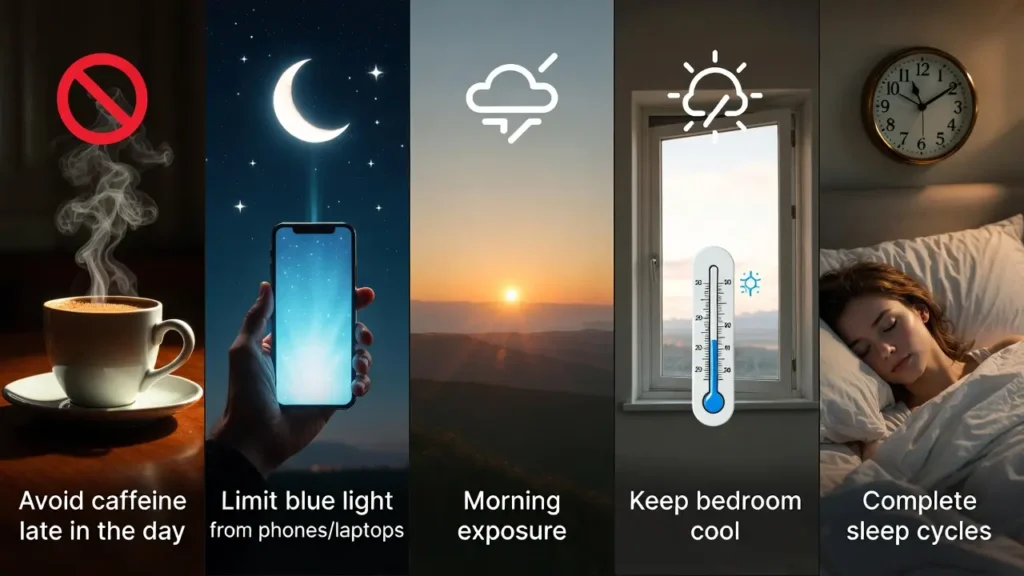
1. Manage Adenosine and Caffeine Levels: Adenosine is a chemical that accumulates in your brain throughout the day, causing sleepiness. Caffeine temporarily blocks adenosine, keeping you awake. However, caffeine can remain in your system for 8–10 hours. For instance, if you sleep at 10 PM, avoid caffeinated drinks after 12 PM to prevent sleep disruption.
2. Align with Your Biological Clock: Your body has an internal clock that responds to natural light and darkness. Spending 10 minutes in morning sunlight can help your body recognize wakefulness, increase alertness, and support melatonin production at night, which is essential for deep, restorative sleep.
3. Avoid Blue Light Exposure: Blue light from phones, laptops, and TVs tricks your brain into thinking it is still daytime, delaying sleep. To improve sleep quality, reduce exposure to digital devices at least one hour before bedtime.
4. Regulate Body Temperature: Research shows that lowering your body temperature by even a degree before sleep significantly improves sleep quality. Using fans, air conditioning, or keeping windows slightly open can help maintain a cool sleeping environment.
Practical Example: Imagine a person who wakes up at 5 AM and sleeps for six hours. To ensure maximum alertness, they should go to bed by 11 PM. Assuming it takes 15 minutes to fall asleep, six hours of sleep allows the completion of four full sleep cycles. Waking up at the end of a sleep cycle ensures optimal alertness. If possible, adding 1.5 hours (an extra sleep cycle) to reach 7.5 hours or even 9 hours provides the highest quality sleep. Skipping or interrupting sleep cycles can result in grogginess, fatigue, and reduced productivity.

In conclusion, it is not the number of hours you sleep that matters, but the number of complete sleep cycles you experience. Incorporating morning sunlight, minimizing blue light exposure, avoiding late caffeine, and maintaining a comfortable sleeping environment can significantly enhance sleep quality. By paying attention to these factors, even a six-hour sleep can feel as refreshing as a longer one, allowing you to wake up energized, alert, and ready to take on the day.
Key Points:
- Sleep quality matters more than duration.
- Complete sleep cycles ensure physical and mental restoration.
- Morning light and darkness at night regulate your biological clock.
- Limit caffeine and digital device exposure before bedtime.
- Keep your bedroom temperature slightly cool for better sleep.

Detailed Explanation of the Article: Understanding Sleep Quality and Cycles
The article focuses on the common misconception that sleeping longer automatically leads to more energy. Many people believe that if they sleep 8–9 hours, they will feel fully refreshed. However, scientific research shows that sleep quality and the completion of sleep cycles are far more important than the total hours slept.
The article emphasizes the concept of sleep cycles, which are natural stages of sleep occurring every 90 minutes. A standard sleep cycle consists of:
- Light Sleep (Stage 1 & 2): The transition from wakefulness to sleep; your body begins relaxing, and your brain activity slows.
- Deep Sleep (Stage 3): Critical for physical restoration, muscle repair, hormone release (like growth hormone), and overall energy replenishment.
- REM Sleep: Important for memory consolidation, emotional balance, and mental restoration.
Key takeaway: Even a shorter sleep duration (like 6 hours) can feel restorative if you wake up at the end of a sleep cycle rather than in the middle. This ensures you are alert and functional, whereas waking up mid-cycle leads to grogginess.
Pros Discussed in the Article
- Scientific Approach:
The article is based on research from leading institutions like the National Sleep Foundation and other sleep scientists. It explains sleep cycles, adenosine, REM, and deep sleep clearly, making it evidence-based. - Practical Advice:
It provides actionable strategies that readers can implement immediately:- Avoid caffeine after midday
- Spend 10 minutes in morning sunlight
- Reduce blue light exposure from phones and laptops before bedtime
- Keep the bedroom slightly cool
- Flexible for Busy Lifestyles:
The article acknowledges that not everyone can sleep 7–9 hours daily due to work or personal responsibilities. By focusing on sleep cycles, even six hours of quality sleep can be effective. - Holistic Approach:
Covers both physical and mental aspects of sleep: physical restoration through deep sleep, mental clarity through REM sleep, and behavioral interventions like regulating light and temperature.
Cons or Limitations
- Requires Self-Discipline:
Implementing the strategies (limiting caffeine, avoiding screens, regulating temperature) requires conscious effort and lifestyle adjustment, which might be difficult for some readers. - Individual Variation:
Sleep needs vary by age, health, and personal biology. While sleep cycles are generally 90 minutes, some people may need slightly longer or shorter cycles. The advice may not perfectly fit everyone. - Does Not Cover Sleep Disorders:
The article is mainly for healthy individuals. People with insomnia, sleep apnea, or other sleep disorders may not see the same benefits without professional help.
Practical Examples We Can Take
- Six-Hour Sleep Scenario:
A person going to bed at 11 PM and waking at 5 AM completes four full sleep cycles. This ensures optimal alertness upon waking. By timing sleep to complete cycles, one can maximize energy even with limited hours. - Adding Extra Sleep Cycles:
If possible, adding an extra 1.5-hour cycle to reach 7.5 hours allows completion of five full sleep cycles, which is ideal for both mental and physical restoration. - Morning Light Exposure:
Spending 10 minutes in sunlight upon waking helps the biological clock reset, promoting alertness and improving melatonin production at night. - Caffeine Management:
Avoiding caffeine after 12 PM (for a 10 PM bedtime) ensures adenosine can accumulate naturally, allowing for faster sleep onset and better deep sleep. - Bedroom Temperature Regulation:
Keeping the room slightly cool with a fan, AC, or open window improves deep sleep quality, making even shorter sleep feel restorative.
Conclusions Drawn in the Article
- Sleep duration alone does not guarantee alertness. It is the completion of sleep cycles and sleep quality that determines how rested you feel.
- Implementing small lifestyle changes, like managing caffeine, reducing blue light, and aligning with natural light cycles, can significantly improve sleep quality.
- Even short sleep periods (6 hours) can be highly effective if timed correctly with sleep cycles.
- Prioritizing sleep quality over quantity is essential for physical energy, mental clarity, and emotional well-being.
Final Message
The ultimate message of the article is: it’s not about how long you sleep, but how well you sleep. By understanding sleep cycles, managing caffeine and blue light exposure, aligning with your biological clock, and regulating your sleep environment, you can achieve maximum alertness, energy, and mental clarity—even if your sleep duration is limited.
The article encourages readers to be mindful of their sleep patterns and adjust their habits to ensure they wake up refreshed and productive. Monitoring your sleep cycles and adopting these practices can transform your energy levels and overall health.
Finally, reflect on your own sleep habits: how many sleep cycles do you complete daily? Comment and share your sleep duration for awareness.